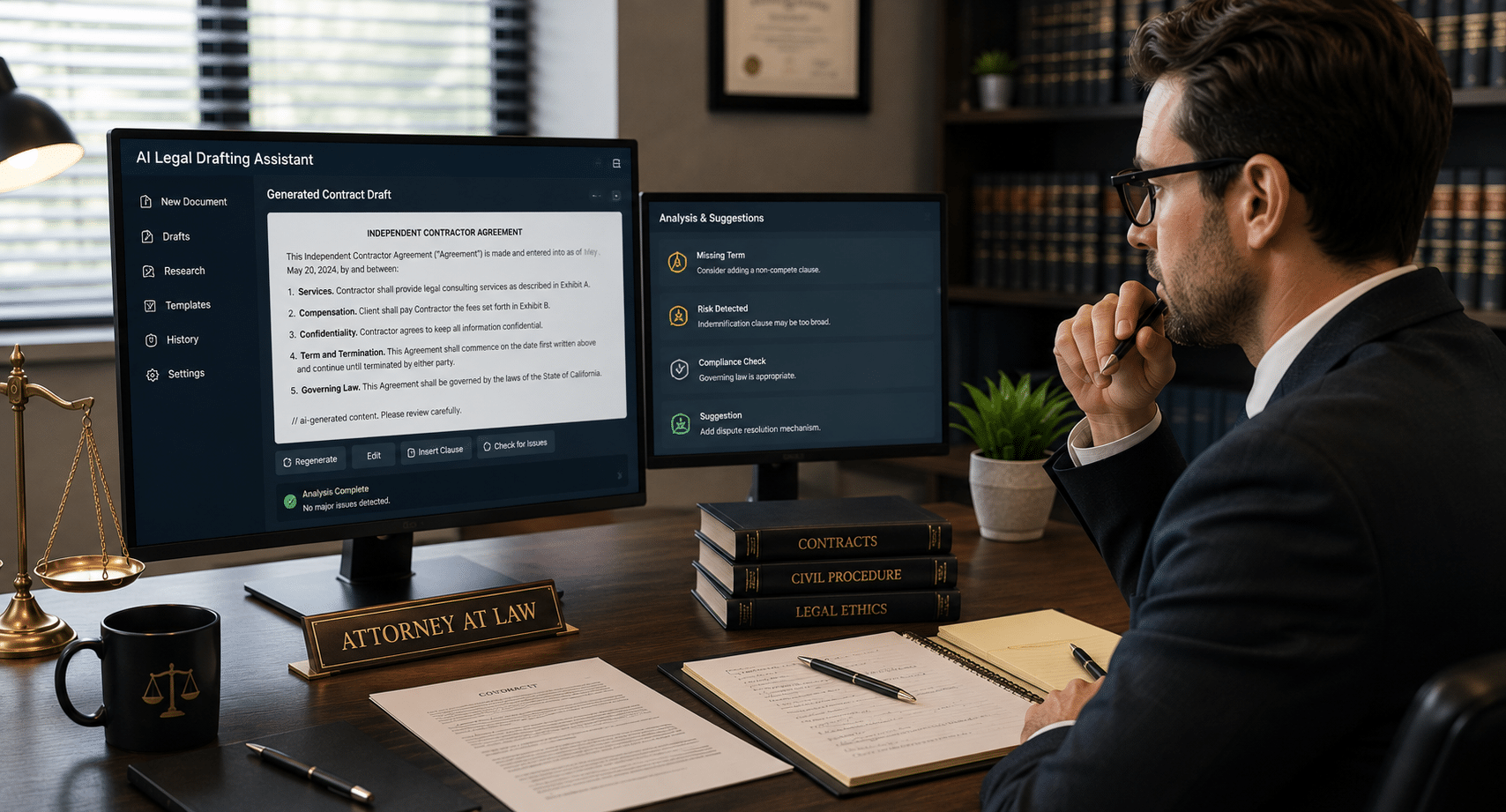
Generative artificial intelligence is changing how lawyers research issues, organize information, and prepare first drafts of legal documents. A law firm may use an AI tool to create a contract outline, summarize a lengthy agreement, suggest alternative clauses, or prepare an initial version of a letter, motion, or internal memorandum. These tools can save time, but they also create legal and professional responsibility risks that cannot be delegated to software.
Lawyers remain responsible for the accuracy, confidentiality, and quality of the documents they produce. An AI-generated draft may contain fabricated authorities, incomplete clauses, incorrect legal standards, or language that does not reflect the client’s objectives. For this reason, generative AI should be treated as a drafting aid rather than a substitute for legal judgment.
Firms developing internal policies may benefit from reviewing how advanced AI risk controls are becoming mandatory in law firms. That broader governance framework is directly relevant when attorneys use AI to prepare contracts, pleadings, correspondence, and other client documents.
Can Lawyers Use Generative AI to Draft Legal Documents?
 Lawyers may use generative AI tools, but using them does not remove their existing professional obligations. The American Bar Association’s guidance addresses duties involving competence, confidentiality, communication, supervision, candor, and reasonable fees when lawyers use generative AI. The central principle is that the lawyer—not the software provider—remains responsible for the legal work delivered to the client.
The American Bar Association’s generative AI ethics guidance explains that lawyers should understand the benefits and limitations of the tools they use. This means attorneys should know how an AI platform handles prompts, stores data, produces responses, and manages user information before relying on it for client work.
Generative AI can assist with routine drafting, but every output requires meaningful attorney review. A document should not be filed, sent to a client, or presented to another party merely because it appears polished and professional.
Why AI-Generated Legal Documents Require Human Review
Generative AI predicts language based on patterns in training data. It does not understand a client’s interests in the same way a lawyer does, and it does not independently confirm whether every statement is correct. An AI-generated contract may omit an important remedy, use an unsuitable governing-law provision, misunderstand a jurisdiction-specific requirement, or create inconsistent obligations between different sections.
The same problem can arise in litigation documents. A system may produce a persuasive-looking motion containing nonexistent cases, inaccurate quotations, or legal principles that do not apply to the court hearing the matter. Even when cited authorities are real, the description of the case may be incomplete or misleading.
Human review should therefore include more than proofreading. The lawyer should independently verify legal authorities, confirm deadlines, evaluate factual statements, check defined terms, identify conflicting provisions, and ensure the document serves the client’s goals.
Accuracy and Hallucination Risks
One of the most widely discussed risks of generative AI is the production of false but convincing information. These errors are often called hallucinations. In legal drafting, a hallucination may involve a fabricated case, an invented statute, a false quotation, or an unsupported statement about court procedure.
Lawyers should verify every authority and material factual claim included in an AI-assisted document. The State Bar of California’s artificial intelligence ethics resources emphasize that attorneys must use generative AI consistently with their existing professional responsibility duties.
A lawyer should also avoid assuming that a newer or more expensive AI platform is automatically accurate. Output quality may vary depending on the prompt, model, data source, practice area, and complexity of the assignment.
Client Confidentiality and Sensitive Information
 Legal documents often contain confidential facts, medical information, financial records, settlement positions, trade secrets, litigation strategy, and personal identifying information. Entering that material into an external AI system may expose it to storage, review, reuse, or unauthorized access depending on the provider’s terms and technical settings.
Before using an AI platform, a law firm should determine whether submitted data is retained, used to train models, shared with subcontractors, transferred internationally, or accessible to vendor personnel. Firms should also determine whether users can disable retention or training and whether the platform offers appropriate contractual protections.
This issue connects closely with broader digital privacy concerns discussed in Cybersecurity and Privacy Law: Protecting Your Digital Rights in California. AI drafting should be incorporated into the firm’s existing cybersecurity, confidentiality, and records-management policies.
Competence and the Duty to Understand AI Tools
A lawyer does not need to become a software engineer before using generative AI. However, the lawyer should understand enough about the tool to recognize foreseeable risks. This includes knowing whether the system retrieves current legal sources, whether it can generate unsupported content, and whether it stores confidential prompts.
Competence also includes knowing when not to use AI. A complex appellate brief, unusual transaction, emergency filing, or high-risk legal opinion may require a level of analysis that should not begin with a generic automated draft. The more significant the matter, the greater the need for careful attorney supervision and independent research.
The NIST AI Risk Management Framework offers a useful structure for identifying and managing AI risks. Its governance, mapping, measurement, and management concepts can help law firms create internal review processes suited to different uses of AI.
Attorney-Client Communication and Consent
Whether a lawyer should tell a client about the use of generative AI depends on the circumstances, applicable rules, and the significance of the technology to the representation. Disclosure may be especially important when AI use creates a material confidentiality risk, affects how a matter is handled, or requires information to be shared with an outside vendor.
Law firms should consider addressing approved AI use in engagement agreements, privacy notices, or technology policies. Any explanation should be accurate and should not overstate the tool’s capabilities or security.
Similar communication issues arise when firms automate the beginning of the attorney-client relationship. The article Legal Risks of Using AI Chatbots for Client Intake at Law Firms explains how automated systems can create confusion about legal advice, confidentiality, and attorney-client relationships.
Supervision of Lawyers and Nonlawyer Staff
AI policies should apply to everyone working with client information, including attorneys, paralegals, assistants, contractors, and outside vendors. A firm may face substantial risk if employees use unapproved public AI tools without understanding confidentiality requirements.
Supervising lawyers should establish clear rules describing which tools may be used, what information may be entered, which assignments require approval, and how outputs must be reviewed. Training should include practical examples showing why client names, medical records, discovery materials, and strategic communications should not be pasted into unauthorized systems.
Firms should also maintain a process for reporting mistakes. Employees may be reluctant to disclose that confidential material was entered into an AI tool unless the firm has a clear and prompt incident-response procedure.
Billing and Reasonable Fees
Generative AI may reduce the amount of time required to prepare a first draft. This raises questions about how firms should bill for AI-assisted work. Lawyers should ensure that fees remain reasonable and that time entries accurately reflect the work performed.
A firm should not bill several hours for a task that took substantially less time simply because the same document would previously have required more manual effort. At the same time, lawyers may generally account for the time spent preparing prompts, reviewing output, correcting errors, conducting legal research, and revising the final document.
Clients evaluating legal costs may also find Understanding Legal Fees: What You’ll Really Pay for a Lawyer useful for understanding hourly billing, flat fees, retainers, and other common arrangements.
Common Types of Documents That May Benefit From AI Assistance
Generative AI may be most useful when a lawyer uses it to create a preliminary structure rather than a finished legal product. Examples may include internal checklists, initial contract outlines, standard correspondence, summaries of nonconfidential material, issue lists, interview questions, and alternative wording for clauses.
More sensitive documents require greater caution. Pleadings, legal opinions, settlement agreements, dispositive motions, estate plans, employment contracts, and regulatory submissions can create serious consequences if a clause or authority is wrong.
The lawyer should evaluate the risk of the particular document rather than treating every AI drafting assignment the same way.
Vendor Due Diligence Before Using an AI Platform
Law firms should investigate an AI provider before allowing the platform to process client information. Relevant questions include:
- Does the provider retain user prompts or uploaded documents?
- Is client information used to train the model?
- Can data retention or training be disabled?
- Where is information stored and processed?
- Does the provider use encryption in transit and at rest?
- Who can access submitted information?
- How quickly will the firm be notified of a security incident?
- Can the firm permanently delete its information?
- Does the contract include confidentiality obligations?
The Federal Trade Commission has warned AI companies to honor their privacy and confidentiality promises. Law firms can review the agency’s guidance on AI privacy and confidentiality commitments when assessing vendor representations.
Best Practices for AI-Assisted Legal Drafting
A law firm can reduce risk by creating a written AI use policy and requiring meaningful human review. The policy should identify approved tools, prohibited information, review requirements, documentation procedures, and responsibility for final work.
Recommended Review Checklist
- Remove unnecessary confidential information before entering prompts.
- Use only firm-approved AI platforms.
- Verify every case, statute, quotation, and procedural rule.
- Compare the draft with current law and reliable legal sources.
- Check defined terms and cross-references for consistency.
- Confirm that the document reflects the client’s objectives.
- Review all calculations, dates, names, and filing requirements.
- Record meaningful attorney review before final approval.
- Do not allow AI to make final legal decisions.
- Update internal policies as tools and guidance evolve.
Firms should also avoid broader operational errors that increase legal exposure. Common Legal Mistakes to Avoid provides additional guidance on contracts, recordkeeping, compliance, and professional advice.
Create Different Controls for Different Risk Levels
Not every AI use presents the same level of risk. A firm may allow broader use for brainstorming or organizing public information while requiring additional approval before AI is used with confidential records or court filings.
A practical policy may classify tasks as low, moderate, or high risk. Low-risk tasks might include generating generic training examples. Moderate-risk tasks may include drafting internal templates. High-risk tasks may include preparing pleadings, analyzing confidential evidence, or creating advice that directly affects a client’s legal rights.
Higher-risk tasks should require stronger controls, including designated tools, restricted access, independent research, and senior attorney review.
Final Thoughts
Generative AI can help lawyers prepare legal documents more efficiently, but efficiency does not replace professional responsibility. Lawyers remain accountable for accuracy, confidentiality, competence, supervision, communication, and reasonable billing.
The safest approach is to use AI for preliminary assistance while keeping legal judgment and final approval in human hands. Law firms should choose vendors carefully, prohibit the use of confidential information in unauthorized systems, verify all legal content, and maintain written policies for review and supervision.
As generative AI continues to evolve, law firms should revisit their policies regularly. Responsible adoption is not simply a technology project. It is an ongoing legal, ethical, cybersecurity, and risk-management responsibility.