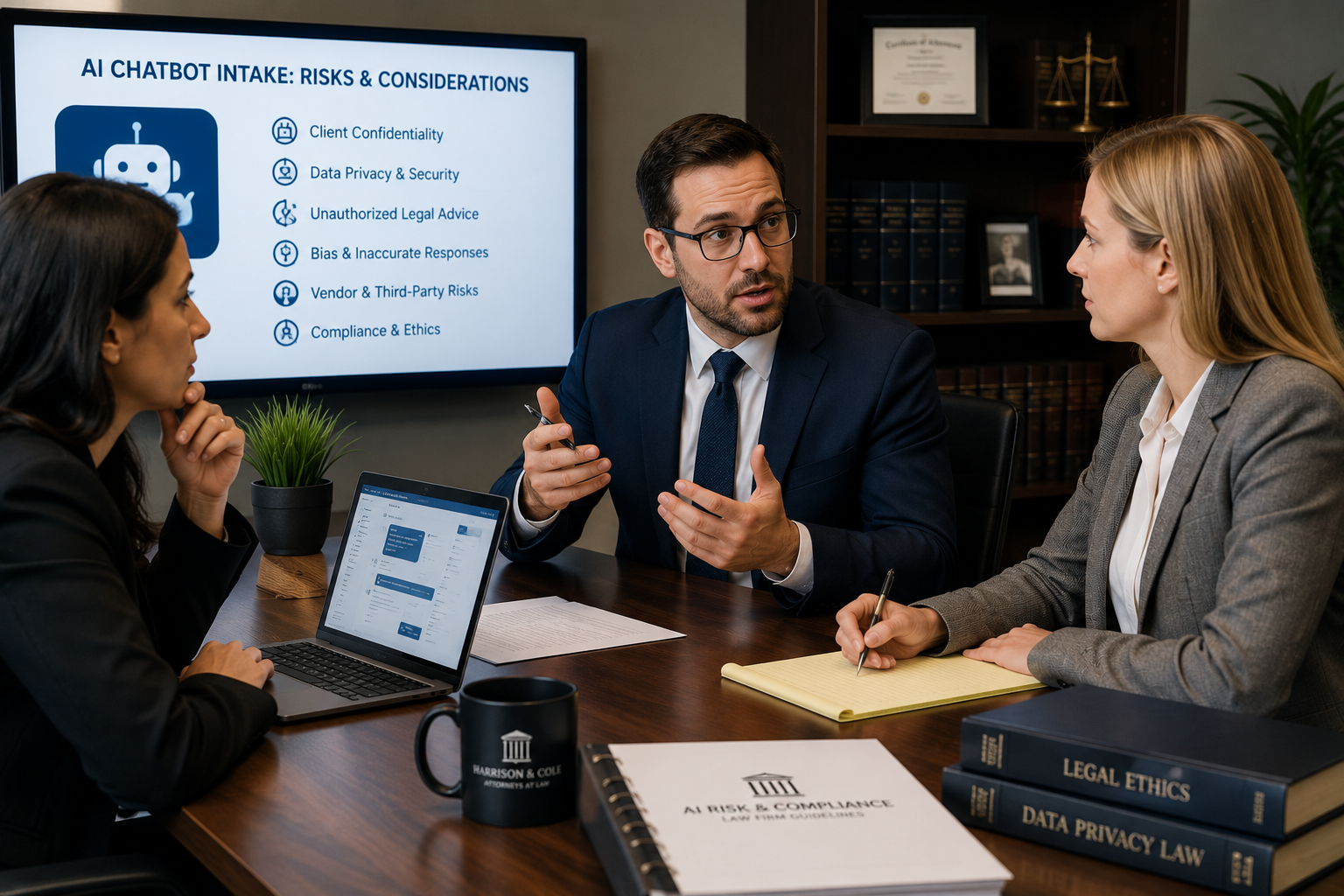
AI chatbots are becoming common on law firm websites because they can answer basic questions, collect contact details, and help potential clients describe their legal concerns. For busy law firms, this technology may improve response time and make intake more organized. However, AI chatbot use also creates legal, ethical, and privacy risks that firms should not ignore.
Client intake is often the first point of contact between a person and a law firm. That first interaction may include sensitive facts about injuries, employment issues, criminal accusations, family disputes, financial problems, or business conflicts. When a chatbot collects this information, the law firm must think carefully about confidentiality, consent, data security, accuracy, and whether the chatbot creates confusion about legal advice.
Law firms already reviewing artificial intelligence policies may also benefit from reading how advanced AI risk controls are becoming mandatory in law firms, since chatbot intake tools are part of the larger shift toward AI governance in legal practice.
Why AI Chatbots Create Unique Intake Risks
Unlike a simple contact form, an AI chatbot can ask follow-up questions, summarize user responses, categorize legal issues, and sometimes generate answers that sound personalized. This makes the tool more interactive, but it also increases risk. A potential client may think they are receiving legal advice when the chatbot is only designed to collect information.
This confusion can become a serious issue if the chatbot gives inaccurate information about deadlines, claim value, required documents, or whether someone has a case. Law firms should avoid presenting chatbot responses as legal conclusions. Clear disclaimers can help explain that the chatbot does not create an attorney-client relationship and does not replace a lawyer’s review.
The American Bar Association discusses professional responsibility and technology issues through its ethics resources, which law firms may review here: ABA professional responsibility resources.

Confidentiality Concerns During AI Intake
Potential clients often share private information during intake. They may name other parties, describe confidential business facts, upload documents, or explain events that could affect a legal claim. If chatbot data is stored by a third-party vendor, sent to an AI model, or reviewed by non-lawyer staff, firms need clear controls around access and retention.
Law firms should understand where chatbot data goes, who can access it, how long it is stored, and whether the vendor uses submitted information to train AI systems. These questions are especially important because client information may be sensitive even before a formal attorney-client relationship begins.
Privacy and cybersecurity issues are closely connected to chatbot intake. Firms handling digital information may also want to review Cybersecurity and Privacy Law: Protecting Your Digital Rights in California for related privacy concepts.
Data Privacy and Security Requirements
AI chatbot intake systems may collect names, phone numbers, email addresses, case details, medical information, employment history, financial records, or location data. If that information is exposed through a breach or mishandled by a vendor, the law firm may face complaints, reputational harm, or legal claims.
Law firms should use secure chatbot platforms, encrypted data transmission, access controls, retention limits, and vendor contracts that address breach notification and data use. Firms should also review whether privacy laws apply to the information they collect. The Federal Trade Commission provides business guidance on privacy and data security here: FTC privacy and security guidance.
For firms using cloud-based tools, cybersecurity planning should not stop with the chatbot itself. Intake data may move into customer relationship management platforms, email systems, document storage tools, and case management software. Each connected system should be reviewed for security risks.
Risk of Unauthorized Legal Advice
One of the biggest concerns is whether an AI chatbot gives responses that sound like legal advice. A chatbot that says, “You have a strong case,” “You should file immediately,” or “You are entitled to compensation” may create problems if no lawyer reviewed the facts. Even general legal information can become risky when it appears tailored to the user’s situation.
Law firms should design chatbot scripts carefully. The safer approach is to keep chatbot functions limited to intake, scheduling, document collection, and general informational prompts. Any case evaluation should be handled by a qualified lawyer or trained intake professional under proper supervision.
Firms should also watch for common operational mistakes. Related guidance can be found in Common Legal Mistakes to Avoid, especially for businesses reviewing risk before problems arise.
Bias and Inaccurate Screening Problems
AI tools may classify intake leads based on keywords, claim type, location, urgency, or estimated case value. If the system is poorly trained or overly automated, it may reject valid inquiries, misunderstand facts, or prioritize certain users unfairly. This can harm potential clients and create business risks for the firm.
Bias may appear when an AI tool interprets language, disability-related descriptions, non-native English phrasing, or incomplete facts incorrectly. Law firms should avoid relying entirely on automated screening. Human review remains important, especially when the inquiry involves urgent deadlines, serious injuries, discrimination, immigration concerns, criminal allegations, or family safety issues.
The National Institute of Standards and Technology provides AI risk management guidance here: NIST AI Risk Management Framework.
Vendor Contracts Matter
Many chatbot tools are operated by third-party companies. Before using one, a law firm should review the vendor agreement carefully. The contract should explain data ownership, confidentiality duties, security standards, breach response, subcontractor access, deletion rights, and whether data is used for model training.
Firms should also ask whether the vendor can support industry-specific privacy needs. A generic chatbot provider may not understand law firm confidentiality, professional responsibility rules, or legal intake sensitivity. Choosing a vendor only because it is inexpensive can create larger risks later.
Best Practices for Law Firms Using AI Chatbots
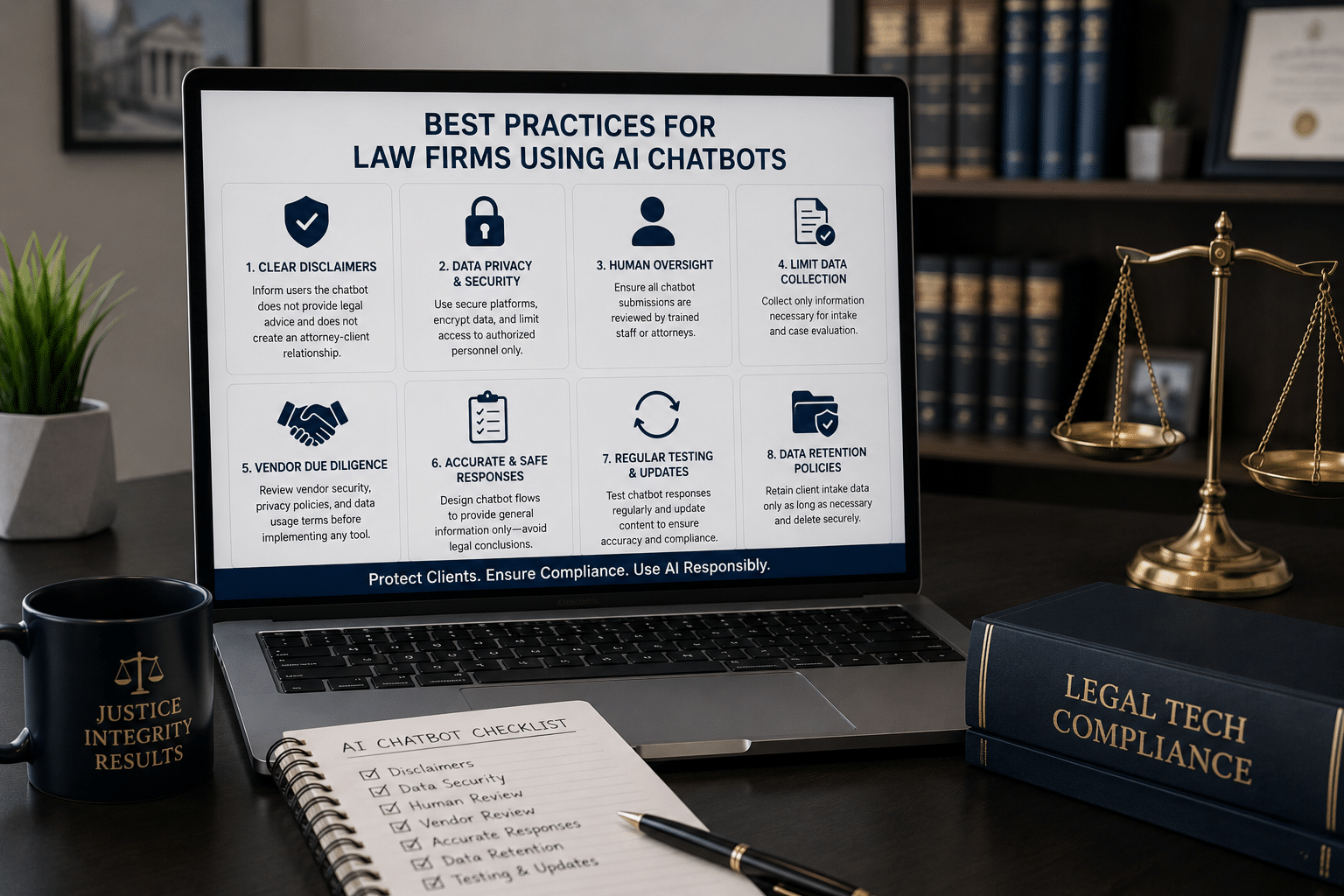
Law firms can reduce risk by setting clear boundaries for chatbot use. The chatbot should state that it is not a lawyer, does not provide legal advice, and does not create an attorney-client relationship. It should avoid making promises, predicting results, or giving legal conclusions.
Firms should also create internal procedures for reviewing chatbot submissions. Intake information should be routed securely to trained staff. Urgent matters should be flagged quickly. Sensitive data should be stored only where needed and deleted when appropriate.
The Cybersecurity and Infrastructure Security Agency offers practical cybersecurity resources that may help firms strengthen digital safeguards: CISA cybersecurity best practices.
Important Safeguards to Consider
- Use clear chatbot disclaimers before collecting detailed information.
- Limit chatbot responses to intake and general information.
- Review vendor contracts for confidentiality and data use terms.
- Protect intake data with encryption and access controls.
- Do not allow AI to make final case acceptance decisions.
- Train staff to review chatbot submissions for urgent legal deadlines.
- Regularly test chatbot responses for accuracy and tone.
- Update privacy policies to explain chatbot data collection.
Final Thoughts
AI chatbots can make law firm intake faster and more convenient, but they must be managed carefully. The risks are not limited to technology. They involve client trust, privacy duties, professional responsibility, vendor oversight, cybersecurity, and the possibility of misleading legal information.
Law firms that use chatbot tools should treat them as part of a broader compliance system. Clear disclaimers, secure data handling, careful vendor review, human oversight, and regular testing can help reduce exposure. As AI tools continue to evolve, law firms that build responsible controls early may be better positioned to serve clients while avoiding preventable legal and ethical problems.