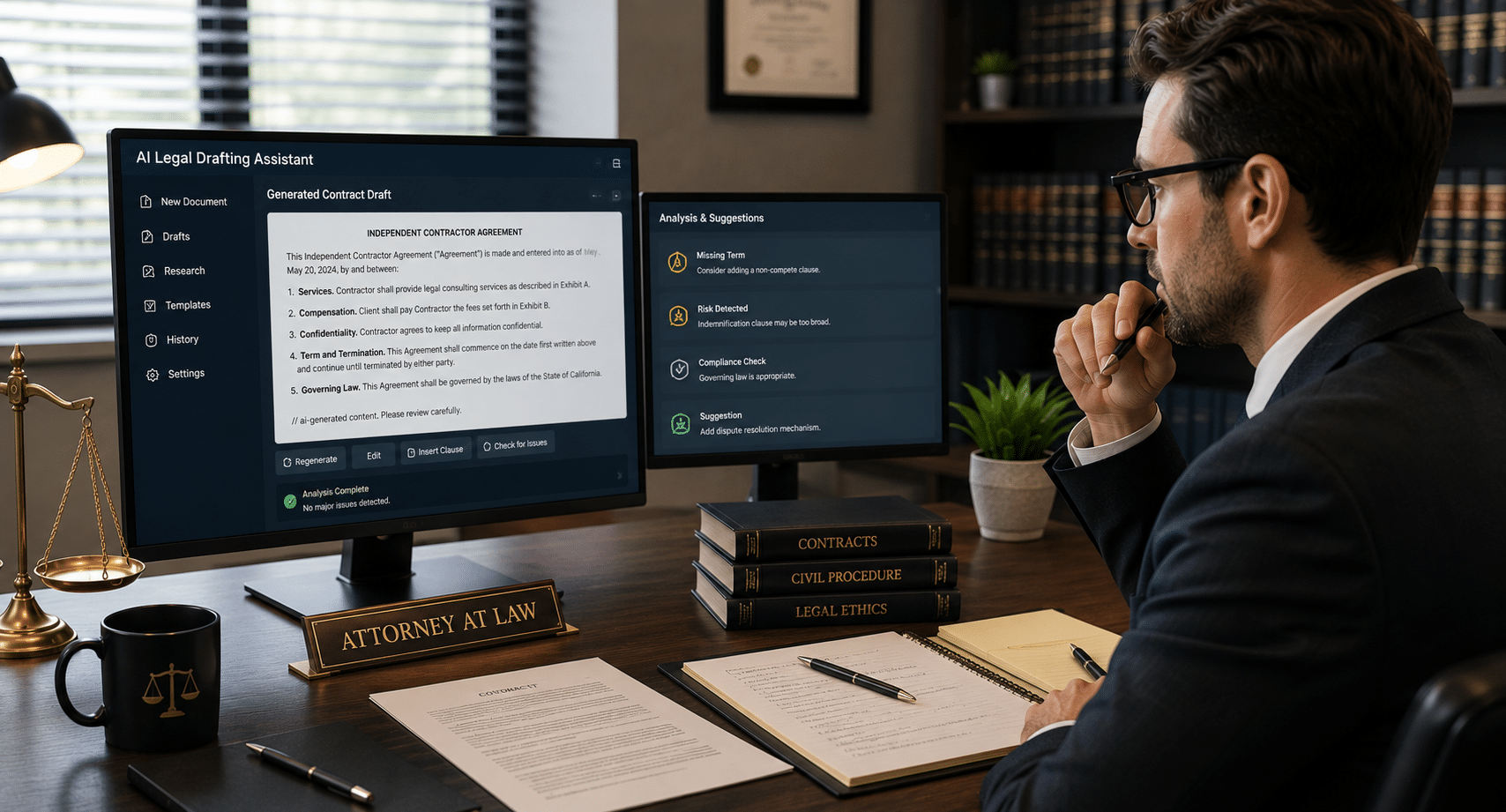
Artificial intelligence is changing how law firms conduct meetings, communicate with clients, and document important conversations. AI meeting assistants can automatically record discussions, generate transcripts, summarize key points, identify action items, and organize follow-up tasks. These features may improve efficiency, particularly for attorneys managing multiple cases, virtual consultations, and complex legal projects.
However, AI meeting assistants in law firms introduce legal and ethical questions that ordinary productivity software may not create. When a digital assistant joins a confidential conversation, the firm must consider recording consent, attorney-client privilege, data retention, vendor access, transcript accuracy, and the possibility that sensitive information could be disclosed.
These issues are different from those involving AI document drafting or automated client intake. Meeting assistants can capture entire conversations, including information that participants never intended to preserve in a searchable digital record.
Law firms exploring these technologies should understand both their practical advantages and the safeguards necessary to protect clients.
What Are AI Meeting Assistants?
AI meeting assistants are software applications that process spoken conversations and produce written records or summaries. Depending on the platform, the software may join a video conference, capture audio from a computer, record a meeting, identify speakers, or create notes automatically.
Common features include real-time transcription, meeting summaries, searchable transcripts, automated task lists, speaker identification, and integration with calendars or practice-management systems.
Some applications operate through cloud infrastructure, while others offer enterprise configurations with additional administrative controls. These differences matter because they affect who can access meeting information and how long the information may be stored.
Although the technology can reduce administrative work, attorneys should not assume that a meeting assistant is simply an electronic version of a handwritten notebook.
Why AI Meeting Assistants Are Different From Traditional Notes
Traditional meeting notes generally capture selected information that a participant considers important. An AI transcription system may preserve nearly every spoken statement, including informal remarks, corrections, personal information, and discussions unrelated to the central purpose of the meeting.
This creates a much larger collection of potentially sensitive information.
A searchable transcript may also be copied, exported, synchronized with other applications, or accessed through an account that has not been adequately secured. These possibilities make data governance an important part of adopting AI meeting technology.
Attorney-Client Privilege and AI Meeting Assistants
 Attorney-client privilege is one of the most important considerations when deciding whether to use AI transcription software during legal consultations.
Generally, the privilege protects qualifying confidential communications between attorneys and clients made for the purpose of obtaining or providing legal advice. Its application depends on the circumstances and governing law.
Introducing an outside technology provider into a privileged conversation can raise questions about whether confidentiality has been preserved. The answer is not necessarily the same for every platform or arrangement.
The American Bar Association has examined the confidentiality risks of AI meeting transcription software, including third-party processing, persistent transcripts, and potential privilege concerns.
Does Using an AI Notetaker Automatically Waive Privilege?
Not necessarily. Whether privilege is preserved may depend on the provider’s role, contractual confidentiality obligations, the purpose of the technology, the degree of control maintained by the law firm, and applicable law.
Third parties who assist attorneys in providing legal services may sometimes participate without destroying privilege. However, lawyers should not assume that every commercial AI platform qualifies for similar treatment.
Before using a meeting assistant for privileged communications, the firm should examine how the provider handles recordings, whether personnel can access them, and whether the service uses information for purposes beyond delivering the requested functionality.
For particularly sensitive discussions, a firm may decide that recording or automated transcription is inappropriate.
Recording Consent Laws May Apply
Another significant issue involves consent to record conversations.
Recording laws vary across jurisdictions. Some states generally permit recording when one party consents, while others impose stricter requirements for certain confidential communications.
California, for example, generally requires consent from all parties before intentionally recording a confidential communication covered by California Penal Code Section 632, subject to statutory definitions and exceptions.
Attorneys should review the applicable law before activating an AI meeting assistant, particularly when participants are located in different states.
The federal electronic communications interception statute also provides important background on recording and interception requirements, although state laws may impose additional restrictions.
Meeting Notifications May Not Resolve Every Consent Issue
Some video conferencing applications display a notification when recording begins or when an automated assistant joins a meeting.
These notifications can support transparency, but firms should not automatically assume that a generic software notice satisfies every applicable legal requirement.
A safer procedure is to establish a clear process for explaining the proposed recording, obtaining any necessary consent, and documenting that consent before recording begins.
Participants should also understand whether the system is recording audio, generating a transcript, preparing an AI summary, or performing several functions simultaneously.
Confidentiality Risks From AI-Generated Transcripts
AI meeting assistants can create detailed records containing confidential client information, litigation strategies, financial details, medical information, settlement discussions, and other sensitive material.
Even if the underlying meeting is conducted securely, the transcript may create a separate exposure risk if it is stored in an external system.
Law firms should understand whether meeting data is retained, whether it is accessible to vendor personnel, and whether it may be used to improve artificial intelligence models.
These concerns are consistent with the confidentiality principles discussed in Cybersecurity and Privacy Law: Protecting Your Digital Rights in California.
Data Retention and Automatic Sharing
Some platforms retain transcripts until a user deletes them. Others may apply organizational retention settings or automatically synchronize summaries with connected applications.
A transcript might be emailed to attendees, saved in cloud storage, attached to a calendar event, or shared with employees who were not part of the original discussion.
Firms should carefully review these settings before allowing a meeting assistant to process client communications.
The ABA Formal Opinion 512 addresses lawyers’ duties involving competence, confidentiality, communication, supervision, and fees when using generative AI.
Although not every meeting assistant operates in the same way, these professional responsibility principles provide a useful framework for evaluating the technology.
Can AI Meeting Transcripts Become Discoverable?
Automated meeting transcripts may create records that did not previously exist. In litigation, those records can raise questions about preservation, discovery, privilege, relevance, and confidentiality.
A transcript is not automatically discoverable merely because it exists. Its treatment depends on applicable discovery rules, the nature of the communication, privilege protections, and the circumstances of the dispute.
However, creating additional records can increase the volume of information a law firm must evaluate when responding to discovery requests or preservation obligations.
Retention Policies and Litigation Holds
Law firms should establish retention procedures for AI-generated meeting records.
Routine deletion policies may be appropriate for some categories of information, but they must be coordinated with legal preservation obligations. Once relevant information is subject to a litigation hold or another duty to preserve, ordinary deletion practices may need to be suspended.
Attorneys should also consider whether transcripts are stored in personal accounts, shared workspaces, or third-party systems that the firm cannot easily search or preserve.
Accuracy Problems With AI Meeting Summaries
AI meeting assistants can misunderstand speakers, omit important qualifications, confuse names, or summarize a conversation in a way that changes its meaning.
A statement that was presented as a hypothetical possibility may appear in a summary as a firm decision. A tentative settlement discussion might be incorrectly described as an agreement. Technical legal terminology may also be transcribed inaccurately.
These errors can create operational and legal problems when attorneys rely on automated notes without checking the underlying conversation.
Why Human Review Remains Necessary
Lawyers should review AI-generated meeting summaries before placing them in client files, distributing them to others, or using them to make substantive legal decisions.
Important deadlines, assignments, settlement positions, and client instructions should be independently confirmed.
Similar verification concerns arise with AI-generated legal documents. Firms developing broader AI governance procedures can review How Advanced AI Risk Controls Are Becoming Mandatory in Law Firms for related risk-management considerations.
Vendor Security and Third-Party Access
An AI meeting assistant may rely on cloud hosting, transcription engines, large language models, and other outside services.
This means the provider’s security arrangements can affect the confidentiality of meeting information.
Before approving a platform, law firms should investigate its data-processing practices, access controls, encryption, retention options, subcontractors, and incident-response procedures.
The NIST AI Risk Management Framework offers organizations a structured approach to identifying and managing artificial intelligence risks.
Law firms can use similar principles when deciding whether a meeting assistant is appropriate for particular types of conversations.
Questions to Ask an AI Meeting Assistant Vendor
- Does the platform record audio, video, or both?
- Where are recordings and transcripts stored?
- Can vendor employees access meeting information?
- Is customer information used for AI training?
- Can training or retention be disabled?
- Does the platform support multifactor authentication?
- Can administrators restrict who receives summaries?
- Are recordings encrypted during transmission and storage?
- Can the firm permanently delete meeting records?
- Does the vendor provide security incident notifications?
- Which subcontractors process the information?
These questions should be addressed before the firm permits confidential client information to enter the system.
Should Lawyers Disclose AI Meeting Assistant Use?
Lawyers should consider whether clients and other participants need to be informed that an AI assistant will process their conversations.
Disclosure requirements may arise from recording laws, professional responsibility rules, contractual obligations, or the particular risks associated with the technology.
For some meetings, clear advance notice and appropriate consent may be necessary. In other circumstances, the most responsible decision may be not to use an automated recording system at all.
The Florida Bar’s Ethics Opinion 24-1 provides additional guidance on confidentiality, competence, and the use of generative AI in legal practice.
Lawyers should follow the rules governing their own jurisdiction rather than assuming that guidance from one state automatically applies nationwide.
Developing an AI Meeting Assistant Policy
Law firms can reduce uncertainty by establishing written procedures governing when and how AI meeting assistants may be used.
A practical policy should distinguish between internal administrative meetings, general business discussions, prospective client consultations, privileged attorney-client communications, and sensitive litigation strategy sessions.
Not every meeting requires the same level of protection.
Recommended Law Firm Safeguards
- Approve specific AI meeting assistant platforms before use.
- Disable automatic recording for sensitive meetings by default.
- Determine whether recording consent is legally required.
- Notify participants when AI recording or transcription is proposed.
- Restrict access to recordings and transcripts.
- Review AI summaries before relying on them.
- Apply appropriate retention and deletion policies.
- Coordinate deletion practices with litigation holds.
- Review vendor security and confidentiality terms.
- Train attorneys and staff on approved procedures.
- Periodically reassess the platform’s features and privacy settings.
Training Employees to Avoid Accidental Recording
One overlooked risk is the automatic activation of meeting assistants through personal accounts or calendar integrations.
An employee may install a transcription application for convenience without realizing that it is configured to join every scheduled video conference.
This can create problems when the application enters a confidential meeting without appropriate review or consent.
Firms should explain how automatic joining works, prohibit unauthorized assistants, and establish a simple process for approving new technology.
These precautions complement the broader risk-management practices discussed in Common Legal Mistakes to Avoid.
Balancing Efficiency With Client Protection
 AI meeting assistants may provide meaningful benefits when used appropriately. They can help teams organize administrative discussions, track assignments, and reduce the burden of preparing routine meeting notes.
However, the potential benefits should be weighed against the sensitivity of the information involved.
For a general internal planning meeting, an approved transcription tool may be relatively straightforward to use. For a confidential consultation involving litigation strategy, the legal and ethical analysis may be substantially different.
Law firms should avoid adopting a single recording policy for every conversation without considering those differences.
Final Thoughts
AI meeting assistants can improve productivity, but their convenience introduces important responsibilities for lawyers and law firms.
Recording consent, attorney-client privilege, confidentiality, vendor security, data retention, discovery obligations, and transcript accuracy all deserve attention before the technology becomes part of routine legal practice.
The most effective approach is to evaluate the specific platform, establish clear internal policies, obtain appropriate consent, restrict unnecessary recording, and maintain meaningful human oversight.
As AI meeting technology continues to evolve, law firms should regularly review their procedures to ensure that productivity improvements do not compromise client trust or professional obligations.